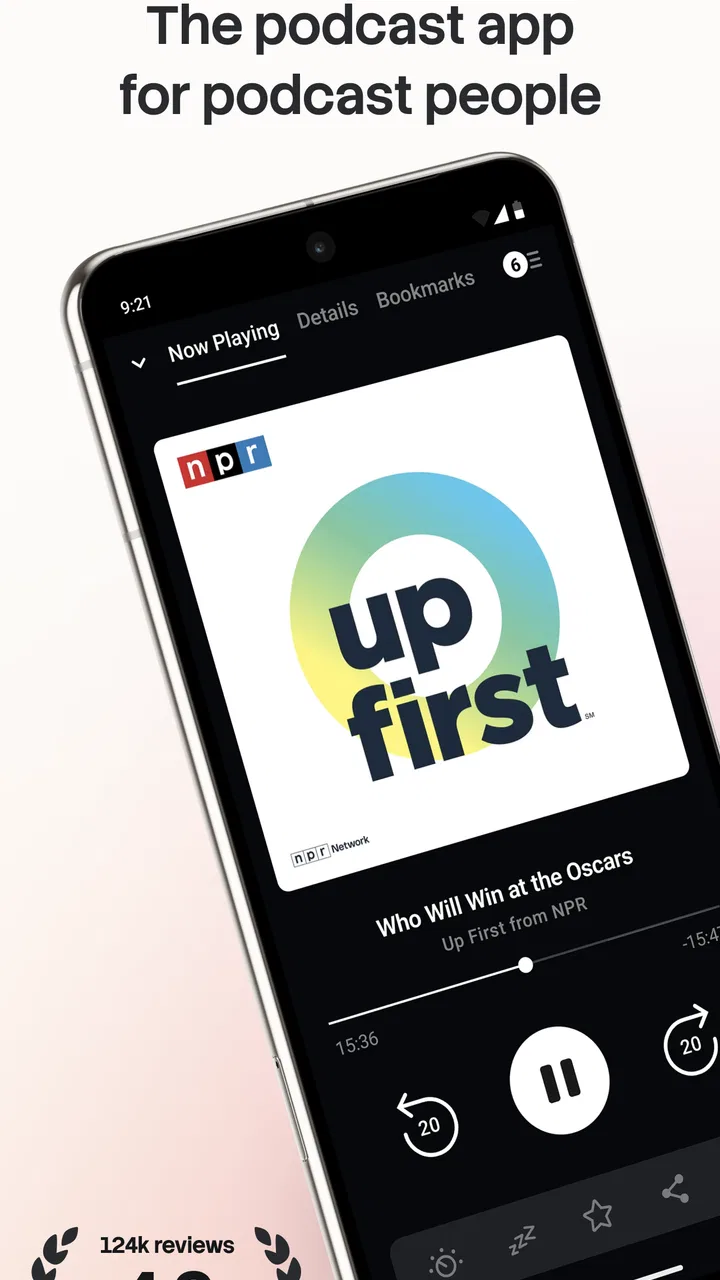
Pocket Casts - Podcast App
- 4.8
- Rating
- 1.00M
- Installs
- Free
- Price

 Analysis by App-foxy
I usually judge a podcast app by what happens after the first download: can I find the right episode quickly, understand what is on screen, and keep listening when my attention, hearing, hands, or connection are not ideal? Pocket Casts makes a strong impression in those everyday moments. It is a free News & Magazines app from Automattic, Inc, built around discovering, streaming, downloading, and organizing podcasts rather than turning listening into a social competition.
That focus matters. A podcast catalog can become difficult to manage once subscriptions, unfinished episodes, saved shows, and downloads begin to pile up. In my experience, Pocket Casts feels most useful when I want a calm listening system instead of a crowded feed. It is rated at 4.8 from roughly 113 thousand ratings, has passed a million installs, and carries a Teen age classification. Those figures suggest broad appeal, but they do not remove the need to consider how the interface works for different people and circumstances.
How Pocket Casts handles reading and navigation
I find that the key to navigating Pocket Casts comfortably is to make the library work for the way I actually listen, rather than trying to keep every episode perfectly sorted. In this section, I look at how show names, episode titles, and a few consistent organizational choices can make it easier to find the next item without adding needless upkeep. That practical foundation matters even more when listening involves accessibility settings or limited time.
You May Also Like

 Blood Strike: 2.5 Anniversary
Blood Strike’s Loadouts Turn Every Drop Into a Tactical Gamble
A close look at Blood Strike’s custom loadouts: how fast access to signature weapons reshapes its battle royale rhythm, rewards preparation, and narrows the gap between fights.

 Pandora - Music & Podcasts
Pandora’s Music Is Easy to Start, but Harder to Recover
Pandora’s strength is its low-effort path from a seed to a station. Its weak spot is how much confidence it asks you to place in connection, setup, and quiet recovery.

 8 Ball Pool
 Is Built on Rivalries, Rematches, and Routine
A close look at the rivalries, rematches, shared routines, and unanswered safety questions that turn a quick pool match into a persistent mobile community.

 Samsung Music
’s Quiet Strength Is Playing What You Already Own
Its reach comes less from spectacle than from dependable access to a personal library. That simplicity is both the app’s strongest retention engine and its ceiling.

 AccuWeather: Weather Radar
AccuWeather Review: A Quick, Clear Forecast for Everyday Decisions
For everyday plans, the best forecast is the one you can understand quickly. AccuWeather makes rain timing, radar, and local conditions easy to act on, with a few trade-offs.

 Hill Climb Racing
Why Hill Climb Racing Still Turns Crashes Into One More Run
A tiny car, a bumpy hill and one more upgrade: Hill Climb Racing keeps resurfacing because its simple chaos makes every near-miss feel personal.
More From Our News Desk



A clear starting point for regular listening
The app’s central idea is easy to understand: follow podcasts, choose an episode, and decide whether to stream it or save it for later. That straightforward structure is helpful for someone moving from radio or a general audio app into podcasts. I do not need to learn a complicated production workflow before I can listen. The important actions are connected to the listening task, so the app feels more like a personal library than a news website filled with unrelated distractions.
Readability becomes especially important in podcast apps because episode titles are often long. A title may include a guest, a topic, a series label, and a part number all at once. Pocket Casts is at its best when I use its organization tools deliberately rather than relying on one endlessly scrolling list. I can treat subscriptions as a shortlist, downloads as a travel queue, and unfinished episodes as a separate reminder of what deserves my attention.
For readers who process information more slowly, this separation can reduce mental load. Instead of remembering which episodes were merely interesting, I can make a conscious decision to download or save the ones I genuinely plan to hear. That is a small habit, but it makes the app easier to use when a large catalog feels overwhelming. I recommend setting up a modest listening routine first and adding shows gradually, rather than importing every podcast that looks appealing.
Organization is more valuable than discovery overload
Many podcast services emphasize recommendations, charts, and constant new content. Pocket Casts can also help me find programs, but its real strength is what happens after discovery. I can build a listening space around my own priorities instead of treating the home screen as an algorithmic magazine. For someone with limited attention or a tendency to lose track of unfinished items, that difference is meaningful.
One useful workflow is to separate listening by context. I might keep short news programs ready for a morning walk, longer interviews for a quiet evening, and downloaded episodes for a journey. This is not just tidiness. It reduces the number of choices I have to make when I am already busy. A person who finds dense menus tiring may benefit from using only a few consistent categories instead of trying to maintain a perfect archive.
The trade-off is that organization still requires personal decisions. The app cannot know whether I will really listen to an episode, and a carefully arranged library can become another task if I overbuild it. I get the best results when I keep the system simple: follow only shows I regularly return to, download with a purpose, and remove old items when they stop being relevant.
What navigation feels like in practice
When I am holding the phone normally, the listening path is familiar: choose a program, select an episode, and start playback. That makes Pocket Casts approachable for people who do not want to study a manual. The app also suits users who prefer to browse visually, because podcast artwork helps distinguish shows that might otherwise have similar names.
Visual artwork is useful, but it should not be the only way to identify content. I pay attention to the written title and show name before pressing play, especially when several programs cover the same subject. This habit helps avoid mistakes and is more dependable for anyone who does not find small artwork easy to distinguish. The app is strongest when its visual cues and text labels work together rather than when I rely on either one alone.
People who use larger text or display magnification may find some screens require more scrolling. Long episode names and descriptive information naturally take space, so increasing text size can make a list less compact. That is not a reason to avoid the app, but it changes the experience: a readable layout may mean fewer items visible at once. I would prioritize comfortable text over fitting more episodes on the screen.
Listening with different motor and sensory needs
The app can reduce how often I need to look at my phone, but a comfortable listening experience depends on more than playback alone. Here I consider how touch demands, screen readability, audio quality, and concentration affect different listeners, including where preparation helps and where the podcast itself remains a barrier. Those needs can also change with the situation, so next I turn to travel, work, and days that rarely go to plan.
Audio-first design helps, but the phone still matters
Podcast listening is naturally useful for people who want to consume information without staring at a display. I can start an episode and put the phone away while cooking, walking, commuting, or doing household work. This hands-free quality is one of the app’s clearest practical benefits. It also means the experience depends heavily on the phone’s audio controls, headphones, speaker, and operating-system settings.
For someone with low vision, the app’s value is not limited to the visuals. Once playback begins, the content can be enjoyed without continuous screen interaction. The challenge comes before and after listening: locating the correct show, selecting an episode, checking download status, and managing the queue. I would prepare those steps in a calm moment rather than attempting them while moving through a busy environment.
For someone who is hard of hearing, a podcast app cannot automatically make spoken content accessible in the same way as written articles. Pocket Casts is therefore a better fit when the listener can comfortably follow audio, use personal amplification, or pair listening with another source of text. I would not choose it as my only information tool if transcripts or captions are essential to understanding every episode.
Reducing repeated taps and awkward handling
Motor comfort is often about reducing unnecessary interaction. A good routine is to prepare a small group of downloaded episodes in advance, then use the playback controls only when needed. This is easier on hands that tire quickly than repeatedly searching, opening menus, and starting a new stream during the day.
There is also a practical difference between a phone that is in my hand and one that is mounted, resting on a table, or connected to another listening setup. Small controls can be harder to hit accurately when I am walking or when fine motor control is limited. I prefer to make selections before leaving home and avoid depending on rapid screen taps in motion. The app supports a better experience when I treat the phone as a setup tool rather than something I must constantly operate.
Long episodes create another motor consideration. Scrubbing through a recording with a small timeline can be frustrating if I am trying to find a particular section. I usually let the episode play and use deliberate, brief adjustments instead of dragging quickly across the entire timeline. That approach is slower, but it reduces accidental jumps and makes recovery easier when I miss the desired point.
Sound, concentration, and sensory comfort
Podcast audio varies widely between shows. Some are carefully produced, while others have uneven volume, background noise, or several speakers talking at different levels. Pocket Casts can organize and play the material, but it cannot make every recording comfortable for every listener. I judge the app separately from the production quality of the podcast itself.
For listeners sensitive to sudden changes, I recommend starting unfamiliar shows at a low volume and checking the first few minutes before settling in. A quiet listening environment can also reveal details that disappear in traffic or a crowded room. Conversely, someone who needs stronger external awareness should avoid becoming dependent on noise-isolating listening in places where hearing surroundings is important.
People with attention-related needs may appreciate the ability to choose a short episode rather than committing to a long one. I find it useful to match episode length to the situation: a brief program during a transition, a longer discussion when I can focus, and saved content when I know interruptions are likely. The app becomes less stressful when I use it to support realistic attention spans instead of treating every subscription as an obligation.
Situational access: travel, work, and interrupted days
A podcast setup that feels manageable at home can become awkward on a commute or between interruptions. I focus here on choosing and preparing episodes before attention is divided, so listening remains practical when connectivity or free hands are limited. The same choices do not suit everyone, however; the final section weighs the app’s focused approach against needs that may call for another kind of tool.
Downloads are the key to unreliable connections
The most convincing everyday use case is a commute or trip where mobile service cannot be trusted. Before leaving, I choose a few episodes and download them while connected to a reliable network. During the journey, I can listen without depending on a live stream. This also makes the app more predictable for people who find buffering, sudden pauses, or changing connection quality disruptive.
Downloading everything is not automatically the best strategy. It can make the library harder to understand and may use more device storage than I expect. I prefer a rotating approach: save enough for the next journey, listen through the selection, and clear episodes that no longer serve a purpose. That keeps the offline collection meaningful and avoids turning it into a second, unmanaged inbox.
A useful accessibility habit is to prepare more than one option. If I know a trip may be delayed, I download a short episode, a longer one, and something familiar. That way I am not forced to search while standing in a station, sharing attention with luggage, signs, or other people. It is a small example of how organization can support situational access without requiring constant screen use.
Different routines need different levels of control
At home, streaming is convenient because I can explore without planning. At work, I may need a predictable episode that can be paused quickly. Outside, I value downloaded content and minimal interaction. Pocket Casts works across these situations because it combines immediate playback with a library I can prepare in advance.
Parents, caregivers, and people with irregular schedules may particularly appreciate this flexibility. A listening session can be interrupted without making the entire plan useless. I would still avoid beginning a long, information-heavy episode when I know I will be repeatedly distracted; a shorter program is often more satisfying than abandoning a complicated discussion halfway through.
The app is also suitable for language learners who want repeated exposure to spoken material, provided the podcast itself matches their level. I would use one familiar show for confidence and one more challenging program for gradual progress. The important point is that the app manages the listening material; it does not replace a dedicated language-learning course with built-in lessons or guaranteed transcripts.
Free access and the question of paid extras
Pocket Casts is free to install, which makes it easy to test without committing money at the beginning. It also includes in-app purchases ranging from a few dollars to amounts near one hundred dollars per item. I would therefore check the purchase screen carefully before paying for anything and decide whether a particular extra genuinely solves a problem in my own routine.
For a casual listener who follows a handful of shows, the free starting point may be enough to judge the basic experience. A more committed listener may find additional paid options appealing, but the value depends on how much time the app saves and how deeply I use its organization tools. I would not pay simply because a feature sounds advanced; I would first identify a repeated annoyance and see whether the purchase addresses it directly.
Remaining barriers and who should choose another option
Pocket Casts is most appealing when I want a dedicated way to manage spoken programs, but that focus naturally leaves some needs outside its scope. In this section, I consider when audio-first listening is a poor fit, why discovery and library upkeep still take effort, and how the whole phone-and-audio setup shapes access. With those limits in view, I can offer a more useful recommendation about who is likely to benefit most.
Audio is not a universal substitute for text
The largest limitation is fundamental: Pocket Casts is centered on spoken audio. If I need searchable transcripts, visible captions, or a fully text-based way to consume news, this is not the right primary tool. A reader app, a publication’s own website, or a podcast service with dependable transcript support may be better for that need.
It is also not ideal for someone who wants a highly social listening experience. People who choose apps mainly for comments, shared queues, public profiles, or real-time discussion may prefer a platform built around community features. Pocket Casts makes more sense to me as a private listening organizer than as a place to meet other listeners.
Likewise, a person who wants music, radio, podcasts, and video in one combined feed may find the dedicated focus limiting. That narrower purpose is a strength for podcast organization, but it means I would need another app for broader media discovery. The right choice depends on whether separation feels calming or inconvenient.
Discovery can still demand patience
Even with a clean library, finding the perfect program can take work. Podcast names are inconsistent, episode titles can be vague, and similar topics may appear across many shows. I avoid judging the app by one unsuccessful search. Instead, I try a few variations, inspect the show description, and listen to a sample before subscribing.
This is especially important for users who rely on precise written information. A polished cover does not guarantee clear audio, a suitable pace, or a comfortable presentation style. I treat discovery as a screening process: check the subject, host, episode length, and sound before adding another ongoing commitment to my library.
There is also a learning curve in deciding how much organization is useful. New users may initially see several possible places for an episode and wonder whether to stream, download, save, or leave it in the subscription list. My advice is to choose one rule for each action. For example, download only what I plan to hear soon, and save only episodes I would be disappointed to lose. Consistent rules make the app more accessible than constantly changing the system.
Accessibility depends on the whole listening setup
I would not describe Pocket Casts as a complete accessibility solution on its own. The experience also depends on screen settings, text scaling, audio hardware, operating-system controls, and the accessibility of each podcast’s production. A listener may find playback comfortable but still struggle with episode selection, or find navigation manageable while the audio mix remains tiring.
That is why I recommend testing the app with a real routine rather than judging it after one quick launch. Try finding a show with larger text, prepare an offline episode, pause and resume during an interruption, and listen through the equipment used every day. Those steps reveal more than simply checking whether the app opens and starts playing.
My inclusive verdict after using it regularly
Pocket Casts is a thoughtful choice for people who want podcast listening to feel organized, prepared, and relatively calm. I especially recommend it to listeners who move between home, work, travel, and offline situations, or who want to reduce the number of decisions made during a busy day. Its focus on managing a personal podcast library gives it a practical identity that broad all-in-one media apps often lack.
From an inclusive-use perspective, its strongest qualities are the ability to prepare listening in advance, rely on audio away from the screen, and arrange content around real routines. Those qualities can help people with visual fatigue, limited attention, unpredictable schedules, or unreliable connectivity. They work best when I set up the library before the stressful moment arrives.
My reservations are just as clear. The app cannot solve the accessibility limits of poorly produced audio, and it is not a substitute for transcripts or captions when text is necessary. Small-screen interaction may still be awkward for some motor needs, and a growing library can become confusing unless I maintain it. Users seeking social features, music, video, or a text-first experience may be happier elsewhere.
For me, the deciding question is simple: do I want a dedicated place to control my podcasts, or one giant media feed that does everything? If the first answer sounds right, Pocket Casts is worth trying. I would begin with a few subscriptions, prepare one offline listening queue, adjust the phone’s text and audio settings for comfort, and observe where friction appears. The best feature is not merely starting an episode; it is making the next listening decision easier.
Automattic, Inc has positioned this as a focused podcast tool rather than a general entertainment hub. With a free entry point, a mature presence dating back to March 6, 2011, and a strong user response, it has a convincing foundation. My final recommendation is positive, with one condition: choose it for organized audio listening, not for features it was never meant to replace. For the right listener, Pocket Casts can turn a scattered podcast habit into a manageable part of the day.
FAQs for Pocket Casts - Podcast App
01What platforms is Pocket Casts available on?
Pocket Casts is available on both Android and iOS platforms, making it accessible to a wide range of users. In addition to mobile devices, Pocket Casts also offers a web app, allowing you to listen to your favorite podcasts on your desktop or laptop for a seamless experience.
02Does Pocket Casts offer offline listening?
Yes, Pocket Casts allows you to download episodes for offline listening. This feature is particularly useful for commuters or users with limited data plans, as it enables you to enjoy your favorite podcasts without requiring a constant internet connection.
03How does Pocket Casts enhance the podcast listening experience?
Pocket Casts offers several features to enhance your listening experience, such as variable speed playback, volume boost, and silence trimming. These options allow you to customize how you consume content, making it easier to enjoy podcasts in a way that suits your preferences and lifestyle.
04Is there a subscription fee for Pocket Casts?
Pocket Casts is free to download and use, but it also offers a premium subscription called Pocket Casts Plus. This subscription provides additional features such as cloud storage for audio and video files, exclusive themes and icons, and access to the desktop app, enhancing your overall experience.
05Are there any social features in Pocket Casts?
Pocket Casts includes features that allow you to share your favorite episodes and discover new podcasts. You can easily share episodes with friends and family or explore trending topics and recommendations, making it a community-oriented platform for podcast enthusiasts.
Pros
- User-friendly interface with intuitive navigation.
- Customizable playback speed options.
- Offline listening for data savings.
- Smart playlists for easy organization.
- Cross-device syncing for seamless use.
Cons
- Paid features may not suit all budgets.
- Limited integration with non-podcast apps.
- Occasional sync issues reported by users.
- No video podcast support available.
- Requires account for cross-device sync.

Pocket Casts - Podcast App
Gallery